

The Way
Choose Life!

The Way
We sometimes forget that, in the beginning, the Christian faith was simply called, “the Way” (e.g., Acts 9:2; 16:17; 18:25; 19:9, 23; 24:14, etc.). I love this practical designation. It wasn’t known as “the Doctrine,” or “the Rules,” “the Faith,“ “the Religion” or “the Tradition.”
The Way was a road or a path. It was a travellers way and a journey. It was a community of pilgrims, traveling together on a journey of discovery and relationship. It was a lifelong pilgrimage.
As is always true of a journey, the Way assumed that choices would be made along the path, opening up new avenues of life. New opportunities and new possibilities.

Practicing the Way
Choices made on the Way would result in practices. While some may prefer an entirely spontaneous, unplanned journey, the story of the Way being told in the New Testament book of Acts, while seemingly unplanned at times, always had a destination in the end. It was a journey of purpose leading to a promised destiny.
Some of the Old Testament Psalms (e.g., Psalm 37) as well as the writings of the early Church Fathers (especially The Didache) became know as descriptions of “the two ways.” Simply put, one way led to life while another led to death. Choosing certain practices along the way could by life-giving or death-dealing.
Each of the “two ways” described a pattern of choices, a “practice” learned and developed over time. A way was more than one fundamental choice but a series of choices. Even if a traveler wandered off the path for a time, in the end, the paths led to a certain destination. Life or death.

Abundant Life
It’s probably most helpful to see the goal of “the way of life” as a flourishing human person. It’s possible to develops a pattern that reflects the glory of God. The other is a pattern of choices that “falls short of the glory of God.”
The glory of God can be understood as the life God intended within the plan and pattern of creation. It is the life God planned for every human person.
It was the second century Church Father who famously said, “The glory of God is a living man,” or “The glory of God is a man [human person] fully alive.” A flourishing human life is the most accurate expression of God’s glory in creation.
It was Jesus who said, “The thief comes only to steal, kill, and destroy. I came that [you] may have life and have it abundantly.” As other translations have it, Jesus came to give us “life to the full” or “the life of the coming age.”
Christian faith was simply called “the Way” in the beginning. It was increasingly understood that it was the way of true, overflowing, abundant life.

“Go and sin no more”
Unfortunately, “religion” all too often sees it as a way of judgment, a practice of determining that some are “in” while others are “out.” It might be quick to communicate rejection and pronounce judgment upon those who are still finding their way on the journey.
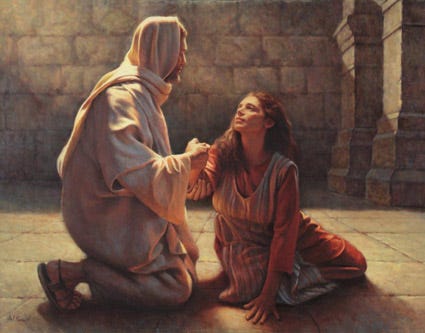
A story of Jesus is often used as justification for this view. The Gospel writer John recounted a story of religious leaders bringing before him a woman “caught in adultery.” They were hoping to show that Jesus was a bit squishy when it came to morality. They asked him what his view was of the law that required such a woman to be stoned (with rocks). (Of course, they were showing their own self-righteous view of things by not bringing the accused man before Jesus as well.)
The story goes on to show Jesus challenging those pious ones to “throw the first stone” if they could claim to be without sin. When no one dared to begin the execution, Jesus responded to the woman, “Neither do I condemn you.” Jesus did not come to pronounce judgement and punishment but rather to provide a way of rescue, a path to abundant life.
And then, Jesus added, “Go and sin no more.” Jesus not only did not condemn the woman but demonstrated his love for her and his commitment to her well-being. He encouraged her to pursue life, to make choices that would allow her to travel the way of true life, to learn how to be the very best possible version of herself. Jesus encouraged the woman to make better choices, to make choices that would enable her to reflect the glory of God in and through her life.
It was Paul who defined “sin” (that hateful word) as a practice or way that falls short of God’s glory, a way that leads to death. As human persons, we are free to make those choices, and frankly, our society tends to encourage if not empower us to make those choices. But we can receive the unconditional love and acceptance of God, and the plan of rescue Jesus came to teach, demonstrate and provide. After all, only unconditional love and acceptance are powerful enough to provide the possibility of heart transformation.
It’s true for us. We can find a way of abundant life. We can choose life!