

"What is Truth?"
Dimensions of "What Is"

In an earlier article, I told the story of how my cousin, when asked by her grandchildren what I was like as a young person, simply answered, “He questioned everything.” I have always thought that to be a good thing. It reminded me of the 18th century “Enlightenment” that encouraged people to “Think for yourself.”
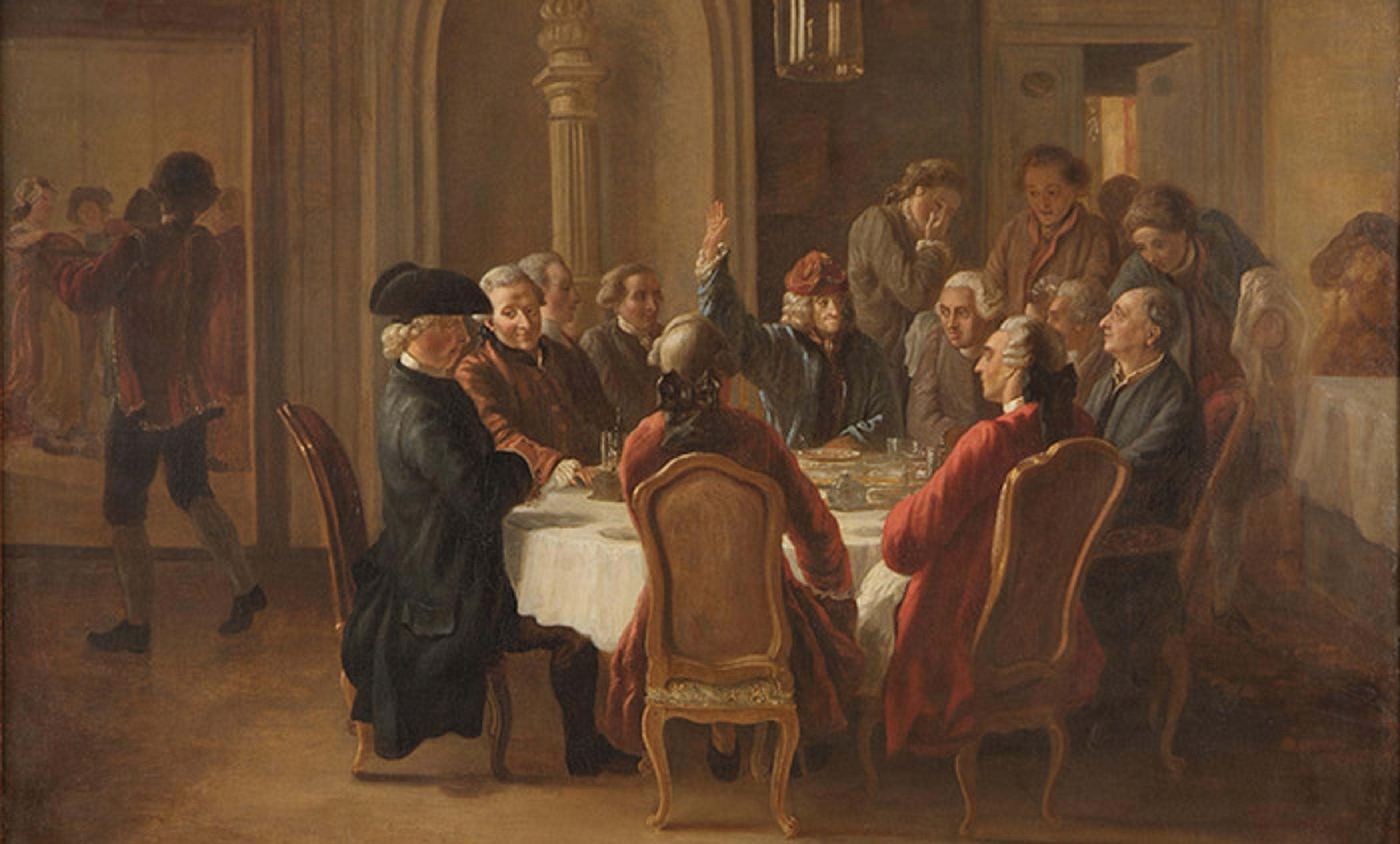
Our “Baby Boomer” generation seemed to be focused on a search for “truth.” While we may have come to very different conclusions, we started with the assumption that there as such a thing as “truth.” The next generation (Generation X) was not as concerned about “truth” as they were “authentic community.” They wanted to move from the “me generation” to a “we generation.” The “millennial” generation seemed to move away from any search for truth, even believing that all truth is personal and individual, “what’s true for you is true for you.” In fact, a belief that some things are true for everyone (“universal truths”) was thought to be an expression of oppression. Millennials also moved from a search for authentic community to a focus on autonomous identity, one that was flexible and could be seen on an “identity spectrum.”
However, we were not the first ones to ask, “What is truth.” When being tried before the Roman governor in Palestine, Jesus claimed, “I have come into the world to bear witness to the truth. Everyone who is of the truth listens to my voice.” To which the Governor Pilate responded, “What is truth?”
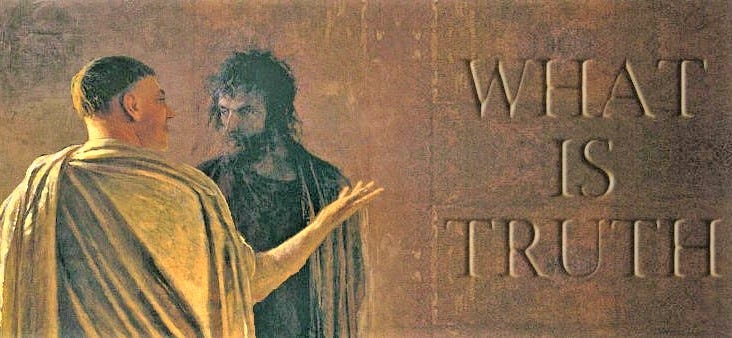
The ancient Greek philosopers posited that truth is simply “whatever corresponds to reality.” I am still convinced that it is proper to question everything as long as we believe there are legitimate answers to those questions.
My background in the study of Scripture reminds me that there are dimensions to truth, dimensions to what is, and that each dimension needs to be explored if there is ever a chance of finding “true TRUTH.”
Original Intent. Because there is a written document explicating ideas (the Bible), the written text can be examined in its original context. The meaning of a text is determined by hearing what the original audience “heard.” As I have often taught - especially in the study of the Apocalypse of John - “it cannot mean what it could not have meant, to the original author and the original audience.” While some ideas have an element of mystery, they were still communicated in a specific context for a specific reason.
Reader Response. Having explored the original intent of an idea, it is then necessary to consider how that can legitimately be applied to the contemporary reader. The application of a text and the consequences of making that application in the lived experiences of readers, must be taken into consideration. Every text must ask clear and relevant “So, what?” questions in order to be truly profitable.

Tradition. It’s simply true that we are not the first generation to seek to find truth, looking at the “original intent” and seeking to find a helpful “reader response.” The big questions have been asked in almost every generation. I assume that at the core, some truths can be profitably applied to a variety of situations and not just be “true for me.” Having a proper respect for the thoughtful considerations of former generations is always helpful in answering questions about truth.
There are many vocations in society that require a good-faith consideration of “what is,” of what is true in a certain context. It is required for some to know how to discern the dimensions of truth and make helpful judgments. (Some would say that includes objective and subjective truth, hard/empirical and anecdotal evidence, or even qualitative and quantitative data analysis.) That is certainly true in education, in teaching and preaching. It is also true for any justice vocation. Whether it be law enforcement, corrections, or the courts, a determination of the “truth” of the matter must look at the original intent, precedent, and a proper application of the truth, including the real-life consequences of that application to justice and the best outcomes to those affected in human life and relationships.
Starting around 1967, there was a significant development among us Boomers. We began to see that Truth was not so much a matter of ideas as it was a Person. We saw with greater clarity that Jesus of Nazareth was not only a Teacher, he was the Truth he was teaching. He was the Word of God. And that made all the difference in our lives. True TRUTH indeed!

As Christians and specifically evangelical Christians we say that we are truth, there is no other. People who don't believe that Jesus is "the way, the truth and the life" are pitied and sometimes degraded as being obstinate or someone who is ignoring the obvious. As I've traveled more I do lean more towards truth is relative to the individual. When I listen to a muslim talk about their faith and traditions who am I to call out their faith as false. When someone who is seeped in a faith and may never have known or spoke to a christian we are pretty egotistical in just saying a individual verse and feel that person should automatically see our point of view and accept our faith.
In conflict management and political movement I've read that there can't be progress until a common ground is established. Whenever there is a discussion of truth there has to be some assumptions and to often our assumption as Christians is we are right and you are wrong.
I was searching for the C.S. Lewis quote on faith that basically says Christ is either who he said he was or he was a madman, but came across another quote that I think gets to the notion of truth for the person. C.S. Lewis said, "I am not asking anyone to accept Christianity if his best reasoning tells him that the weight of evidence is against it". Until we get to a point with an individual that we can talk about our common grounds and what are our differences we can never have a discussion of what is truth. As Lewis said we may disagree, but we disagree with a much deeper understanding.
Thank you for your articles.
Alan